
Ethernet Cabling in Portland, OR & Vancouver, WA
Cat6 Ethernet drops run, terminated, and tested — wall jacks, patch panels, and tidy cable paths for homes and offices.
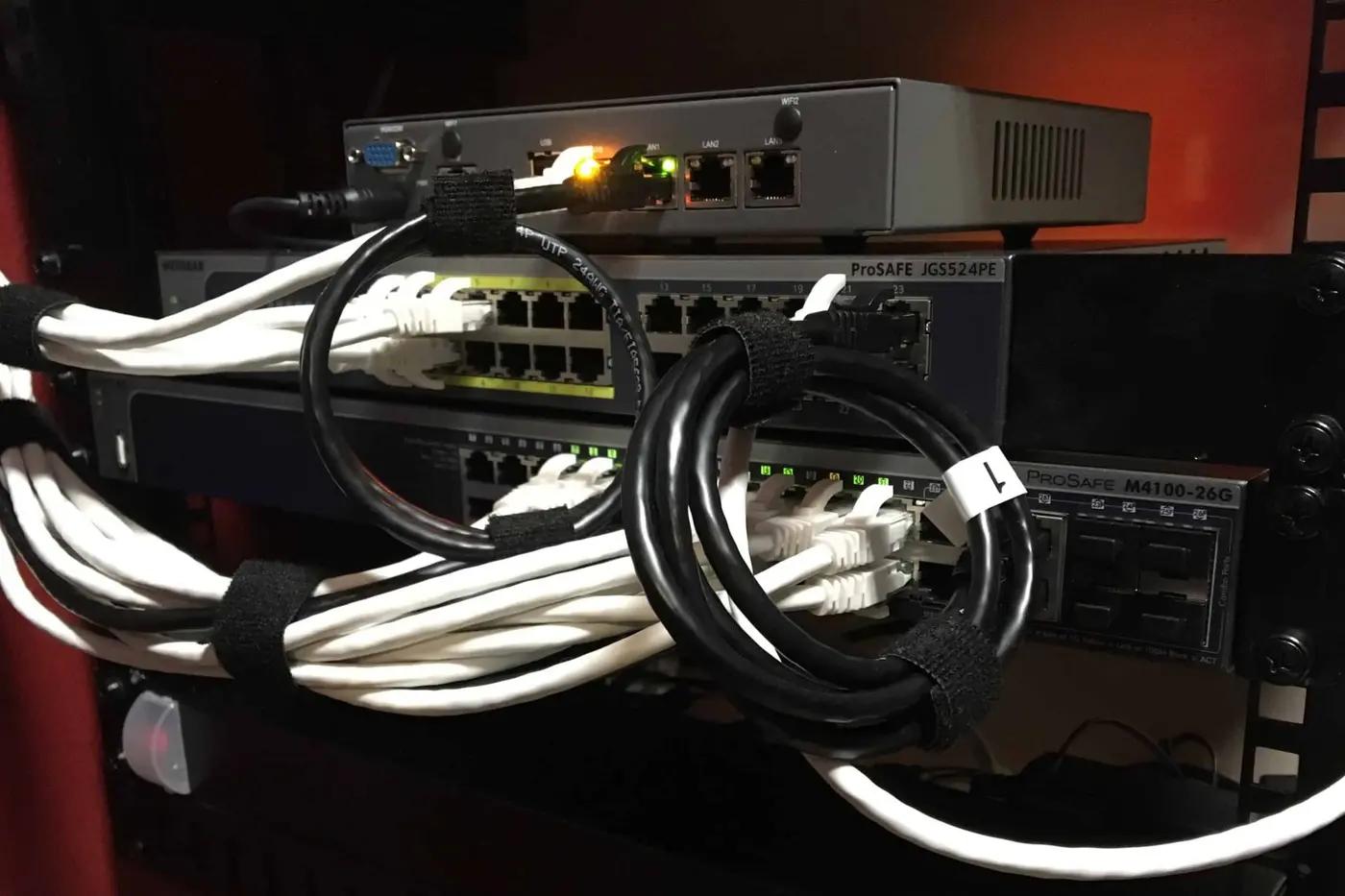
Ethernet runs done right — cable routed through walls, attics, and crawlspaces to land exactly where the desk, TV, camera, or access point needs it, terminated in proper jacks or a patch panel, then tested and labeled.
What's Included
- Cat6 Ethernet runs
- Wall jack & keystone install
- Patch panel termination
- In-wall & attic routing
- Testing & labeling
- Cable management
What We Install & Repair
Cat6 runs pulled through walls, attics, and crawlspaces to land exactly where the desk, TV, camera, or access point sits — terminated on proper keystone jacks or a patch panel, then tested pair by pair and labeled at both ends, not judged by whether a link light comes on. This is low-voltage work only: we route around electrical wiring, and we never touch it.
- Cat6 drops to desks, TVs, cameras, and access points
- Wall plates and keystone jack terminations
- Patch panel installation and termination
- Fishing cable through finished walls, attics, and crawlspaces
- Testing every run and labeling both ends
- Taming existing cable tangles into something serviceable
Common Problems We Solve
A jack that only ever links at 100 Mbps.
Nine times out of ten that is a termination fault — a split pair or one conductor not fully seated. We re-terminate both ends to spec and test the run; if the cable itself was damaged in a past install, we show you which section has to be replaced.
A Wi-Fi dead zone that no router upgrade has fixed.
Some rooms will never get good wireless through what is between them and the router. The durable fix is a cable to that room — feeding either a jack for the device or a small access point — a routing problem solved in the attic, not at the store.
Cable stapled along the baseboard from an old install.
We pull the surface run out and re-route it inside the wall or under the floor, landing it on a flush wall plate. Where a concealed path does not exist, low-profile raceway painted to match is the honest second-best, and we say so before starting.
Old phone jacks all over the house, none of them useful.
Genuine Cat3 phone wire cannot carry modern Ethernet, but it makes a perfect pull string for new Cat6 along the same path — and some 1990s houses hide usable Cat5 behind their phone plates, which re-terminates for data.
How It Works
Scope the route
We check what stands between the panel and each drop: attic access, crawlspace clearance, fire blocking, and what the walls are made of. Lath and plaster — standard in much of older Portland — gets a slower, more careful plan than open drywall bays.
Pull the cable
Runs go through the attic or crawlspace wherever possible, fished down inside the wall to a cut-in box. Drill holes are minimal and placed to miss plumbing and wiring; any opening we must make is cut cleanly so the patch is small.
Terminate
Drops land on keystone jacks in wall plates at the room end and on a patch panel or labeled jacks at the head end — no bare cable dangling out of a hole, no crimped plugs where a jack belongs.
Test and label
Every run gets a wire-map and performance test, and both ends get matching labels — you end up with a sheet listing each drop, where it lands, and its result.
What's Not Included
- Anything line-voltage — outlets, junction boxes, panel work. If a route needs an electrical change, a licensed electrician does that part.
- Underground runs to shops and outbuildings — surface conduit can be quoted, but trenching is another contractor's work.
- Fiber splicing and terminations — copper is our lane; fiber ends go to a specialist.
- Plaster texture and paint restoration — where a wall must be opened, we patch the hole flat; matching a historic finish is a painter's job.
What Affects the Price
- Number of drops
- Each additional run in the same visit costs less than the first, since the setup, attic time, and head-end work are shared.
- Route difficulty
- An open attic over drywall is fast; blocked plaster cavities, tight crawlspaces, and two-story fishes multiply the time per run.
- Head-end finish
- Landing a few runs on labeled jacks is quick; a mounted, documented patch panel takes longer and is worth it past four or five drops.
- Wall openings
- Most runs need none, but a route with no concealed path may require access holes — each one adds cutting and patching time.
Frequently Asked Questions
Cat6 or Cat6a — what should go in the wall?
Cat6 handles gigabit at any home distance and 10-gigabit over shorter runs. Cat6a future-proofs long 10-gigabit runs but is stiffer, fatter, and harder to fish through old framing. We default to Cat6 and suggest 6a only when a specific run justifies it.
Can you run cable without tearing up my walls?
Usually, yes. Most drops route through the attic or crawlspace and fish down inside the wall, leaving nothing but the new plate. The exceptions are insulated exterior walls and blocked plaster cavities, where a small access hole is sometimes the only way — we say so before cutting.
Is wired really better than good Wi-Fi?
For anything stationary, yes — not just peak speed, but consistency. A cable does not share airtime with the neighbors, drop during a video call, or add latency when the microwave runs.
How long can a run be?
The spec allows 100 meters — about 328 feet — per run including patch cords, and nothing in a house or small office comes close — the route is the constraint, never the distance.
What does testing actually involve?
Each run gets a wire-map test confirming all eight conductors are terminated correctly with no split pairs, plus a link test at the speed it should support. Ports that fail get re-terminated until they pass.
Areas We Cover
Free estimate
Request a Free Ethernet Cabling & Wall Jacks Estimate
Tell us what you need and we'll get back to you with a quote. Photos welcome.