
Outdoor Installation in Portland, OR & Vancouver, WA
String lights, sheds, play sets, mailboxes, and outdoor fixtures installed and anchored for the weather.
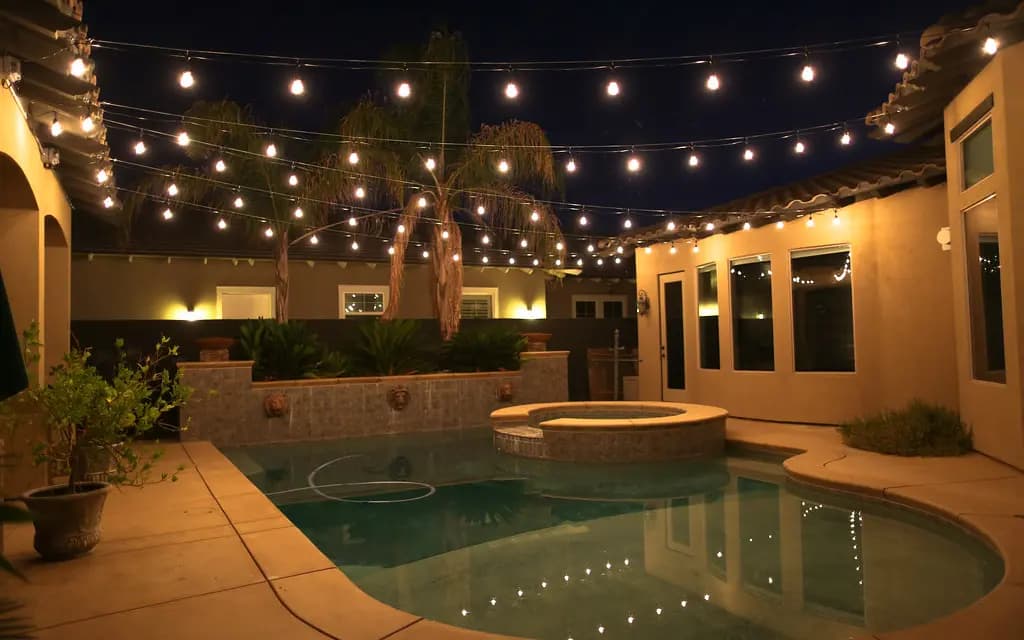
Outdoor projects installed to survive a Pacific Northwest winter — string and patio lighting hung, sheds and storage assembled, play sets and trampolines built, mailboxes and house numbers set — everything anchored and sealed for wind and rain.
What's Included
- String & patio lighting (plug-in)
- Shed & outdoor storage assembly
- Play set & trampoline assembly
- Mailbox & house numbers
- Grill assembly
- Weather-rated anchoring
What We Install & Repair
Anything installed outdoors here gets nine months of rain and a few real windstorms to prove itself, so the job is less about the thing and more about the anchoring. We hang string and cafe lights, set mailbox posts, mount house numbers and flag brackets, and build the big backyard flat-packs — sheds, play sets, trampolines, grills. On the lighting side we work plug-in and low-voltage only: the moment a project needs new wiring, it needs a licensed electrician, and we say so at the quote.
- String and cafe lights hung on tensioned guide wire (plug-in and low-voltage)
- Mailbox posts set plumb, wall-mount boxes and house numbers installed
- Flag brackets, hose reels, and small exterior fixtures mounted
- Shed and outdoor storage assembly, anchored down
- Play set and trampoline assembly with wind anchoring
- Grill and outdoor furniture assembly
- Mounting penetrations in siding and masonry sealed against water
Common Problems We Solve
String lights that sagged and died their first winter.
Lights hung by their own cord always fail — the wet cord stretches, sockets tip, connections pull apart. We run tensioned stainless guide wire between solid anchor points, and the light string rides the wire carrying none of its own weight.
Nothing to anchor the far end of a lighting run to.
We check what's available first — an eave, a solid post, a mature tree with a proper standoff. An old fence post that wiggles is not an anchor. When the yard genuinely has nothing, we set a dedicated post in concrete.
A mailbox post that's rotted off at the ground or been clipped by a car.
The old stub comes out, a new post goes in plumb and set in concrete, and the box mounts at carrier height. Wet ground eats untreated posts fast here, so we use ground-contact-rated lumber or a sleeved steel post.
A trampoline that wants to travel.
Unanchored trampolines move in the storm gusts that roll through every winter. We assemble it square and drive auger-style wind anchors matched to your soil — soaked lawn holds very differently than dry.
How It Works
Photos and a plan
Send photos of where things are going and what they'd attach to. What a fixture mounts to — cedar siding, brick, stucco — decides the hardware.
A quote with the hardware named
Guide wire, anchors, sealant, post material — listed so you know what's going in and why it's rated for weather.
Install day
Assembled, mounted, anchored, and sealed in one visit for most projects. Lighting runs get powered up and tested before we pack the ladder.
Walk-through
We show you how things come down if they ever need to, and what's worth a glance each fall — tension on the wire, caps on the anchors, sealant lines intact.
What's Not Included
- New exterior circuits, outlets, or any hardwired fixture — including swapping a hardwired porch light. That's line-voltage electrical work and goes to a licensed electrician; we work from the outlets you already have.
- Concrete slabs and flatwork — we set posts in concrete, but pads and footings for larger sheds are a concrete contractor's job.
- Fence and deck construction — fence and gate repair is its own service here, and building new fence lines or decks is beyond both.
- High tree work — lighting runs that need climbing beyond ladder height go to someone with the rigging for it.
What Affects the Price
- What's being assembled
- Parts count drives time — a mailbox is an hour or two, an 800-piece play set is a full day for two people.
- Mounting surface
- Drilling and anchoring into brick or concrete runs slower than lag-screwing into wood framing, and the hardware costs more.
- Lighting span and anchor points
- Total run length, how many corners it turns, and whether an anchor post has to be set all add to the day.
- Ground conditions
- A post hole in loose fill digs in minutes; the same hole in saturated clay or root-laced ground is real work.
Frequently Asked Questions
Will string lights survive a Northwest winter outside?
Yes, if they're commercial-grade strands hung on guide wire — most people leave them up year-round. The failure mode isn't rain; it's cord-carried weight and cheap sockets that let water sit in them. Good hardware and a proper hang solve both.
Can you put lights where there's no outdoor outlet?
Sometimes. A low-voltage transformer plugged into an existing exterior outlet can push a run a long way. What we won't do is bury an extension cord and call it wiring — if the layout truly needs a new outlet, that's an electrician's job first, and we'll hang the lights after.
Is there a required height for a mailbox?
For curbside delivery, USPS wants the box floor 41 to 45 inches above the road and the face set back 6 to 8 inches from the curb line. Carriers can and do flag boxes outside that window, so we set posts to spec.
Does a trampoline really need to be anchored?
In this climate, yes. A trampoline is a sail with legs, and the wind events we get most winters are enough to flip or launch one. A wind-anchor kit installed into firm ground is cheap insurance against your trampoline visiting the neighbor's roof.
Can a shed be assembled straight onto grass?
No — it needs a level, drained base or the floor racks, the doors bind, and the bottom edge wicks water. Small resin sheds do fine on a leveled gravel pad, which we can build. Larger wood-frame kits want a slab or framed foundation — we'll say which yours needs before assembly day.
Areas We Cover
Free estimate
Request a Free Outdoor Installation & Assembly Estimate
Tell us what you need and we'll get back to you with a quote. Photos welcome.